
The seven principles of cat-friendly care
Being a cat owner is a privilege – but cats can be tricky to read, and their needs aren't always obvious.
International Cat Care has developed seven principles that define what truly cat-friendly care looks like, and they underpin everything we do as a gold Cat Friendly Clinic.
Here's what each one means, and why it matters for your cat.
Respect cats
Cats are not small dogs. They have their own very specific needs, instincts and ways of communicating – and understanding those is the starting point for everything else.
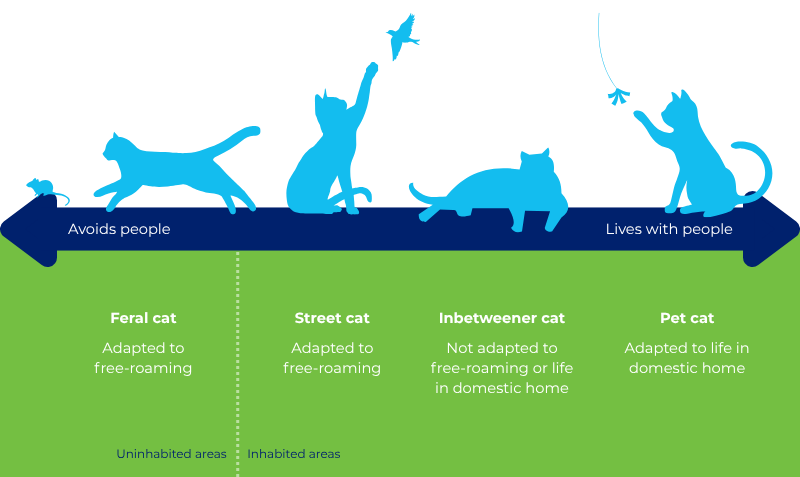
The diagram shows what they are called, where they are found and how close a relationship they might want with people in their homes.
Every cat is an individual. Their personality and behaviour are shaped by genetics, their early experiences in the first two months of life, and their ongoing environment. Things like age, health and stress also play a big role in how they act day to day.
At their core, all cats share some fundamental needs – regular food and water, a safe and comfortable place to rest, somewhere to toilet, and opportunities to scratch, rub and play out their natural instincts. Getting these right makes a real difference to how settled and content your cat feels.
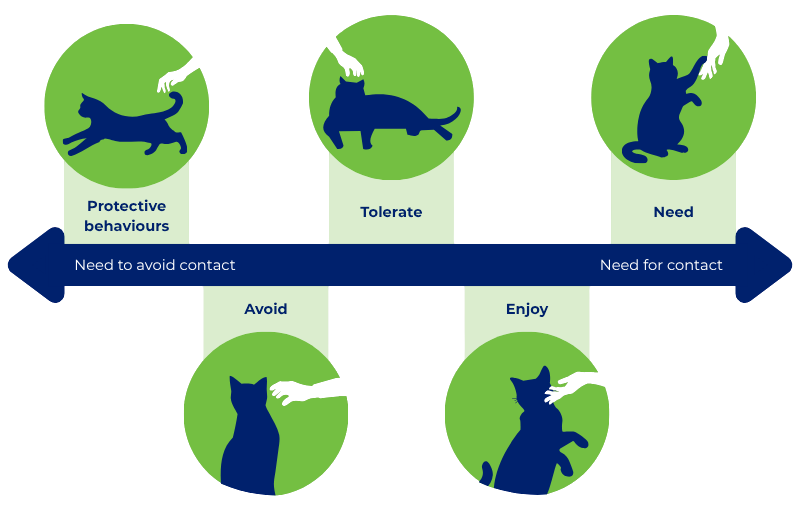
Every cat is different – some actively seek out fuss, others prefer to keep their distance. Learning to read your cat's signals is one of the best things you can do for them.
Keep cats well
A cat's physical health and mental wellbeing are closely connected – you can't have one without the other.
Keeping cats well isn't just about treating illness when it arises. It's about understanding how your cat is feeling day to day – whether they're comfortable, relaxed and able to express natural behaviours – and taking action when something seems off.
Cats are emotional animals. Pain, discomfort, anxiety and stress all affect how they feel and behave, often in subtle ways. Knowing your cat's normal means you're better placed to notice when something isn't quite right.
Do cats no harm
This one sounds straightforward, but it's broader than you might think.
Harm doesn't just come from obvious things like rough handling. It can also come from well-intentioned actions – feeding the wrong food, using products safe for other pets but not cats, or pushing interaction on a cat that would rather be left alone.
Cats aren't small people, either. It's natural to project feelings onto our pets, but interpreting a cat's behaviour through a human lens can sometimes lead us to miss what they're actually telling us. Taking cats on their own terms, with patience and respect, is the best way to avoid inadvertently causing stress.
Be solution driven
Good cat welfare isn't passive. It means looking at the root cause of a problem rather than just managing the symptoms – and being willing to make changes, even when that takes effort.
Whether it's a cat that's anxious at the vet, struggling to settle at home, or showing signs of a health issue, the most helpful response is always a considered one. Doing nothing isn't a cat-friendly option.
Communicate for cats
Cats can't speak for themselves, so the people around them need to communicate well on their behalf.
That means vets and owners sharing information openly, asking questions without judgment and talking through concerns before they become problems. It also means us explaining things clearly – in plain language, without jargon – so you always understand what's going on with your cat and what the options are.
If something doesn't feel right, or you're not sure about something we've advised, please do ask. We'd always rather you asked than went home uncertain.
Collaborate for cats
No single person or organisation has all the answers when it comes to cat welfare. The best outcomes for cats happen when vets, owners, behaviourists and other specialists work together.
That collaborative approach starts with you. We see the relationship between a cat owner and their vet as a genuine partnership – you know your cat better than anyone, and that knowledge is invaluable to us.
Evolve for cats
Feline medicine continues to develop, and so do our understanding of cat behaviour, stress and wellbeing. What's considered best practice today is better than it was ten years ago – and it will keep improving.
Our team stays up to date with the latest guidance, training and research because we believe our cats deserve nothing less. Our gold Cat Friendly Clinic status is part of that commitment – but it's also just the starting point.
If you have any questions or concerns, don't hesitate to get in touch with our team — we're always happy to help.
This article was inspired by guidance originally published by International Cat Care (iCatCare), a leading authority on feline health and welfare. We're grateful for the excellent resources they provide to cat owners and veterinary professionals worldwide.